Zach Cregger’s Resident Evil comes as the third film in his directorial career, all within the span of about 4 years. Barbarian is one of my favourite horror films and Weapons was a great success and also a really great film. Cregger claims he came up with Weapons, Resident Evil and his upcoming The Flood all in one creative burst after finishing Barbarian — I’m very intruiged by The Flood, but Resident Evil was an instantly exciting prospect for me. Earlier this year I finally decided to get into the Resident Evil series in preparation for Resident Evil Requiem.
I ended up absolutely adoring the games I played. What I love about Resident Evil is its variety in perspectives, locations and even tone. Resident Evil 2 (remake) had a constant sense of dread with Mr. X following you around with no pause for your maze throughout the RCPD and surrounding areas. Resident Evil 4 was far more action-based, being set in Spain and the vastly different locations you visit including a castle, boating across to islands and a horrifying underground lab. All of these locations accompanied by very corny villains, but it works. Resident Evil 7: biohazard even completely reinvents the tone and feel of the series with first person perspective, and much more of a focus on this singular family infected by the mold in their house, the main character is just a regular guy trying to find his wife.
All that to really exemplify the vast variety of appeal in the Resident Evil brand.
How do you go about adapting Resident Evil to the big screen?
Well that question has split Resident Evil fans for a while. Paul WS Anderson made multiple, but it starred Milla Jocovich as original character “Alice”, and while it does feature Resident Evil iconography, these are mainly early 2000s (into 2010s apparently) action spectacles. They tried making an “extremely faithful” one with Resident Evil: Welcome to Raccoon City by merging 3 whole games and casts into one 2 hour film.. it didn’t work unsurprisingly.
Resident Evil the film franchise vs Resident Evil the game franchise have completely opposite reputation, and due to that it’s even harder to really start from scratch with a new take on adapting the games. Resident Evil has prestige to it, yet these films are seen as awful and oversaturated. It’s a tough undertaking, one that Zach Cregger decided to take. In a way, the shift to a director that commands the conversation of the film almost as much as the brand itself is smart. There’s an element of my excitement for this film that was because of my interest in Cregger as a growing filmmaker, and my trust in his choices, as well as my general fandom of Resident Evil.
However, I come from a perspective of loving films and video games. A lot of Resident Evil fans have really dug into Cregger and examined his every word to prove he is actually a hack. Cregger is a fan of the series which should be a good sign, but to fans he is too surface level to claim he is “one of them”.
Cregger’s Resident Evil features only a handful of direct references to the lore and story of Resident Evil at large. The main character is supposed to be an NPC in the games, an organ delivery man for a hospital, and he just gets caught up in the Raccoon City outbreak on accident. So, Raccoon City is a major part of this film, and we even visit it, and the Umbrella Corporation are responsible for it.
Cregger takes liberties with the established timeline, because had this film been set in the 90s and not been snowing, many fans would’ve been able to take what Cregger was putting down here, but that one creative liberty goes against the game and thus proves it’s a very seperate thing. Cregger did specifically claim the film took “alongside Resident Evil 2”.
It’s fair to be hesitant, seeing your favourite games adapted in a format more people are going to see and potentially change up the fandom as they know it. Gamers have a very set way of how things should be represented, and messing with the identity of a series, huge changes don’t go over very well. This is especially true for Zelda, Wind Waker was hated to no end when it first got revealed. Similarly to Wind Waker, Cregger’s Resident Evil has had many pre-judgements and strong opinions that it truly feels like the decision was made on the film when that first trailer dropped.
How Cregger succeeded in adapting Resident Evil
The video game movies of the past few decades have repeatedly failed to understand the appeal of the games they’re adapting. Arguably, the most successful ones have been entirely different takes on their respective series. The Sonic films for example have been pretty successful, and it took until the third movie to essentially adapt a game’s story into those movies. Before they largely were just Sonic in the real world. I was partial to Pokémon: Detective Pikachu, I really felt taking the detective story approach allowed to show off an aspect of the Pokémon universe that isn’t commonly shown. Neither of these are particularly concerned with adapting the feel of their respective game series’ but they’re appealing to the iconography of them and sharing their world with audiences who may be unfamiliar.
If you look at some other video game adaptations, like this year’s The Super Mario Galaxy Movie that I enjoyed purely from a fan perspective but it is literally just a compilation of every recognisable element of Mario crammed into one relatively incoherent mess. Comparing that to A Minecraft Movie, it’s the exact same issue, you’re smothered with references and plots designed in a lab to appeal to lowest common denominator while also being a guaranteed hit with fans. This conundrum is the exact opposite of many earlier adaptations, like DOOM (2005), Super Mario Bros. (1993) and Monster Hunter (2020) that are almost embarassed to be based on video games, trying to be serious or taking away so much from the original games that you question why it’s based on the game to begin with. Or it’s just dull in Monster Hunter’s case as well.
So, all that build up is to say, this has been a heated debate among Resident Evil fans — does Zach Cregger’s Resident Evil deserve that name? Is it actually an adaptation or is it just putting that name on for more views. Well, firstly, Cregger probably doesn’t need the franchise bump for his films as Weapons proved successful a year prior, but also when watching the film it’s really a quintessential Resident Evil-feeling film.
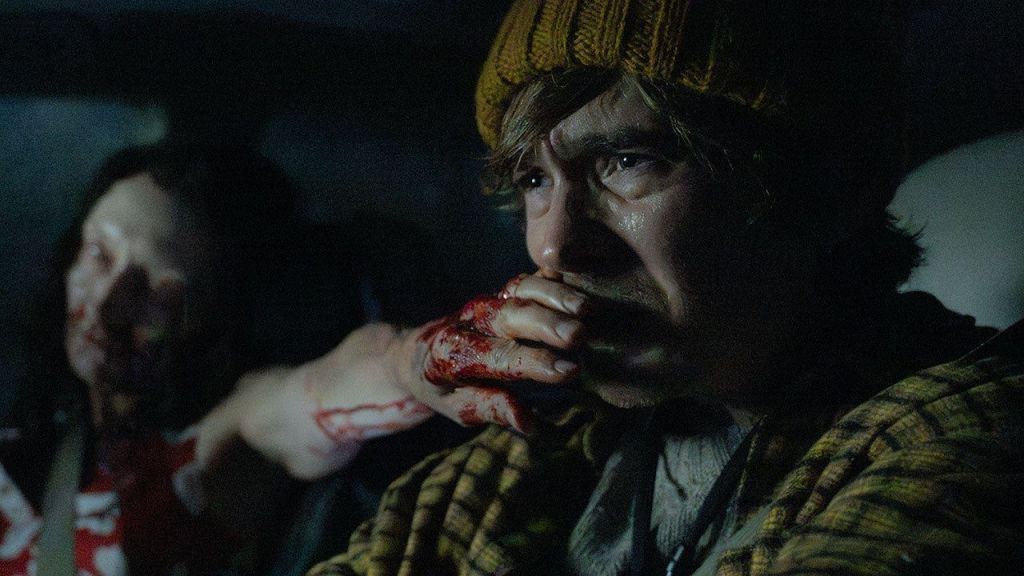
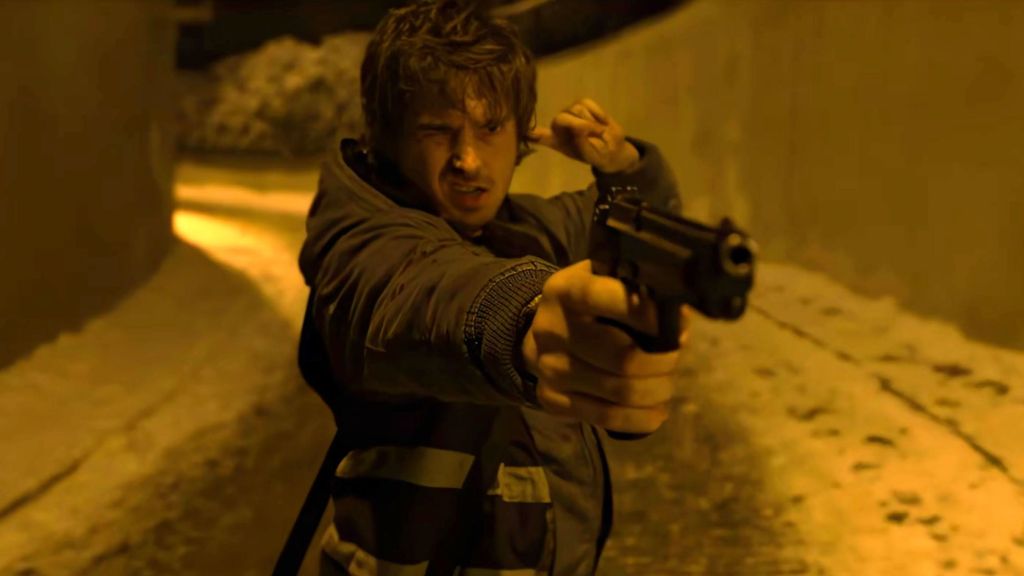
No, there aren’t any characters from the games, and Cregger takes many liberties with the setting, clearly implying the events of Resident Evil 2 are now in modern day when it’s snowing, but regardless of that, it doesn’t really impact the intent of the film. And the intent of the film is this constant journey deeper and deeper into a bad situation. It’s Bryan’s worst ever day and yet it literally does not stop getting worse progressively. Unlike many RE protagonists, Bryan, played by Austin Abrams by the way, is an average person, and not trained. Honestly, Bryan is designed as an NPC in one of these games you wouldn’t follow, but in a way Bryan is also kind of us as a player inserted into this narrative. He has to adjust to his situation, find ways to pass locked gates, find ammo, get progressively better weapons, endure a sewer level and so much more.
I feel the film hinges on Bryan as a character, and I felt the film delivers on that thanks to Austin Abrams. He plays Bryan so funnily, but also earnestly. I love how Cregger centers the entire narrative around Bryan’s unwillingness to settle down and choose his future as he remains in limbo with his girlfriend as he won’t make a decision on whether she should keep the baby. Bryan is punished for this by being forced into a situation where his life is very much in danger and he is forced to come to terms with what he actually wants. I love how the film takes the stalker enemy concept from the game and makes it a metaphor for Bryan’s indecision and internal conflict, a nuclear family literally rolled into one chasing Bryan.. his demise ultimately coming from the desire to protect a child from danger. It all harkens back to my favourite Resident Evil narratives being personal and exploring a character’s psyche.
In a way that no other video game adaptation that I’ve seen, Resident Evil just really emulates the feel of playing these games while not having to directly adapt a certain game or character to do so. Resident Evil doesn’t always have the same cast, and while the ensemble has increased and Capcom do often bring back characters, these games are so different from each other but there is an undeniable quality to a Resident Evil game and it’s just in the DNA of them. I feel Cregger really understood that DNA and put it in his film. I honestly felt like I was experiencing a Resident Evil film through the film, and a great one at that.
At a tight 90 minutes, it really hits all the beats and felt like a playthrough. The ending honestly made it feel like it was a bad ending route, where Bryan as a player stand-in was punished for his actions during the campaign and how it caught up with him. While there is so much humour in this film, it leaves you feeling a little depressed because it’s really a tragedy but that’s what’s most impressive to me is Cregger’s balance of tension, emotion and brevity and none of these three aspects undermine each other and instead are precisely why this works as they benefit each other.
★★★★½
Excellent
Resident Evil (2026) is an incredible achievement in craft but also tension, and successfully emulates the tone and feel of Resident Evil without having to be a melting pot of references and cheap copies of already existing games. It’s not just a great video game adaptation, it’s a great movie and an incredible horror movie and more video game movies just need to be actually good movies on their own before they start taking off.

