Author: Luca Newton

  • How We Deal With the End of the World – ‘Bugonia’ & ‘A House of Dynamite’

    How We Deal With the End of the World – ‘Bugonia’ & ‘A House of Dynamite’

    11th November 2025

    It’s been a couple weeks since my last post, mainly because I’ve been quite busy with other things, but also because of the few major films I’ve seen since the last review I’ve either had little to say — or in the case of a couple films I’m going to be talking about today, I feel they compliment each other quite well in what I would want to discuss about them.

    The two films are Bugonia, directed by Yorgos Lanthimos, and A House of Dynamite directed by Kathryn Bigelow. On the surface, these films feel very different from each other to two very extremes; Lanthimos’ films being known for their weird, unsettling, absurd films with heart, Bigelow known more for films with a more serious representation of war. Arguably, the first time Lanthimos and Bigelow films can intercept in the way they have for me here, because Bugonia left me with some weirdly complicated feelings on the ways it serves its characters, how their beliefs and flaws are almost undermined by the direction of the story, but how the overwhelming pessimism really works and leaves you impacted. I overall really liked Bugonia, but I equally felt a little baffled by what the film was really trying to tell me, when it felt the need to completely undermine what I had felt was the message at the time. However, it has been a couple weeks, and I have since also watched A House of Dynamite on Netflix, and while my feelings are largely negative on it, I found that reflecting on it makes me understand Bugonia more in a weird unintentional way. These two films are both essentially about the powerlessness of humanity, and that is something both very beautiful and terrifying. It’s why I wanted to write about both in one big post here because I found the parallels so fascinating.

    It’s 2025, halfway through the 2020s; the cursed decade. We are about to experience the onslaught of films based on the first half of this decade, but you already know what happened if you’re reading this now. To start the decade, we had both a global pandemic and the fear of nuclear war, and while the latter did calm down quickly after, it’s still a threat that pops its head out time to time. Global relations are the most publicly rocky they have been for a while, Russia invading Ukraine, the 100 year long ethnic cleansing of Palestine by Israel, the 2024 US election putting you-know-who back into power. I could go on, but you probably already know all this, so what’s my point? Well, I’m setting the scene here for perhaps the most overtly pessimistic decade where we are completely aware of how bad things are without just burying our heads in the sand like we used to. Obviously, people are still doing that as they always will, but it feels like we’re increasingly more aware. While we are in the rise of censorship, and stripping back of diversity to “fight back” against “the woke mind virus”, the filmmakers of any generation will always form their art around the truth.

    For better or for worse, Bugonia and A House of Dynamite both feel like products of the past five years. They both ask the question: Are we ready for the end of the world?

    Are We All Insane?

    From the very start of Bugonia, it becomes very obvious what the core metaphor of this film is. Through Robbie Ryan’s stunning cinematography, the day in a life of a worker bee is portrayed, paired with a voiced-over conversation between the two central characters Teddy and Don; Teddy explaining the process the bees go through. Teddy is a beekeeper, but he is also a low level employee for Auxolith Corporation, a pesticide manufacturing company. Teddy then mentions how bee colonies are increasingly suffering from Colony Collapse Disorder, which is when a colony of bees leave their colony, abandoning their food source and their queen. He believes Auxolith’s pesticide is causing this to happen, and the reason for this is because the CEO of Auxolith, Michelle Fuller, is actually an alien that wants to kill all humans, and by getting rid of bees, it can accelerate the process. Though the usage of bee imagery is certainly for the CCD parallel, I think foundationally it draws parallels with Michelle Fuller as a queen bee while Teddy is a worker bee that’s abandoning his colony so to speak.

    Anyway, Teddy, played excellently by Jesse Plemons, is portrayed as mentally unstable from the start. He seems very isolated, and distrusting. Despite that, his best friend and cousin Don is by his side. Don seems quite impressionable as he’s implied to be autistic I believe, and Teddy cares deeply for him, but equally he wants to fill Don’s mind with his own beliefs. Teddy’s fixation on his conspiracy theories of Auxolith’s CEO being an alien is depicted as insanity, and as we unpack more about his history, we find out about how Auxolith’s pesticides caused his mother to enter a permanent coma. So much of the situation is tragic, and then we later find out that Teddy was sexually assaulted by his babysitter, that is also a cop, when he was younger. These two major traumatic events helps you to see Teddy in a different light, he is undoubtedly insane and quite psychopathic, but its rooted in some raw, unresolved trauma, and he’s taken it out on society as a whole.

    Our first introduction to Michelle Fuller is honestly fascinating. The ominous, unsettling score from Jerskin Fendrix plays over the morning routine of Michelle, and it is all we can hear. We see her from behind windows, from the outside of her car, and are fully detached from her entirely. It’s such a fascinating way to introduce her, but it ultimately dehumanises her in a way that Teddy does. He sees her, but is incapable of actually knowing her from anywhere but afar. There is a glass wall between “them” and “us”. Emma Stone is phenomenal as Michelle Fuller, as she really conveys this inhumane CEO, that only uses corporate language, and has absolutely no care in the world for other human beings unless it impacts her business. Yorgos’ framing of Teddy and Michelle for their first appearances paints two pictures; the one that Yorgos wants us to believe, and the one that is the final twist. What he wants us to believe is what I said above, about Teddy’s mental psychosis, how Teddy dehumanises Michelle but doesn’t actually know her. The truth is that it ultimately puts a glass wall between the audience and Michelle as we aren’t allowed to grow attached to her as a person and only see her as a cold corporate figurehead, and with the sinister music and constant distance, the film is actively dehumanising her and telling us she is deceiving us.

    Yorgos is playing with us and consistently changing how we perceive the truth. At first, the true outcome felt it undermined the point of the film, and arguably I still feel it might, but I think with time I’ve seen how the uncertainty of the truth and the powerlessness we as a species have over our planet can cause anyone to spiral. Teddy has been indoctrinated by the internet, he’s obsessive over going deeper down a rabbit hole, and his cousin Don gets caught in the spiral. Ultimately, the two of them take different meanings from it; Teddy’s determination to heal his mother and get revenge contrasting Don’s disdain for life as it is, his feeling of complete isolation from anyone. The result is Teddy becoming a serial killer, and Don sadly choosing to no longer be alive. It’s a very dangerous spiral and it happens in real life, but the rug-pull of Bugonia is that Teddy was actually right. My gripe with this is that does making Teddy actually right glorify this kind of behaviour. It’s a matter of perspective though, because ultimately the final moments of this film spiral into complete insanity leading to the full extinction of humanity, so effortlessly done by Michelle’s alien queen form. What Yorgos presents is a reality check, Teddy may have been right, but he poked the wasp’s nest (Well, that’s kinda fitting..), and in turn doomed humanity. Michelle didn’t even have the intention to kill humanity, instead wanting to keep it alive, but that goodwill was destroyed, and we as a species must suffer the consequences. All of humanity just stops on what seemed to be a normal day, and it’s extremely unsettling and extremely pessimistic.

    I felt maybe Yorgos was undermining the message of the dangers of the indoctrination of impressionable minds, but Teddy is condemned possibly in the most devastating way possible. Instead, I like to think Bugonia is showing us that we’re ultimately just bugs, and we can be squished so easily. Our hubris, our sense of power, it’s all completely pointless because it can be undone with one well-timed stomp of the shoe.

    Powerlessness in the Face of Our Demise

    I have less favourable thoughts on A House of Dynamite. Beyond a decent opening 40 minutes, Bigelow’s choice is to completely change the cast twice after. A House of Dynamite is a film about how the USA would deal with nuclear war, from the perspective of the workers and politicians at the top. Ensemble films, especially in the scenario of the film, absolutely have a place, and I can imagine a different edit of this exact film being better by default. I think my issues are more deep-rooted, there are many threads not picked up on at all; Kaitlyn Dever is in this movie for one scene, and is never mentioned again, but her role as the estranged daughter of the Secretary of Defence that happens to live in the state that is about to blow up, is seemingly unimportant to the bigger picture. I get why though, because the film is balancing so many big figures in the scenario that having some random guy try to reach his daughter again is unimportant. Arguably, that is antithetical to what a film about humans dealing with the end should be preoccupied with rather than showing us an abundance of offices and awkward silences. The POTUS is a character for the third act, and in concept, a film about the President having to deal with doomsday plans AND do normal PR stuff at the same time is more entertaining to me than a condensed trivial version. Essentially, A House of Dynamite is an ensemble film, 3 films in one, but maybe it should’ve focused on a different group of people. Perhaps the focus on the very human relationships in this uncertain time would be compelling.

    If that sounds similar to Bugonia, that’s because in a different context, it is similar. Teddy and Don are overwhelmed with uncertainty of humanity’s fate, and Teddy has decided to take it upon himself to save the planet himself. The focus on the human element from well defined characters offers a unique perspective for us as an audience, especially with Teddy and Don’s dynamic, it gets you really invested in their characters, and there are stakes through that. A House of Dynamite‘s stakes peak way too early.. The aforementioned first act actually did a good job of having these stakes. While the characters aren’t as well defined as they could be, you share that common fear and hopelessness as it all seems completely pointless. Unlike Bugonia, A House of Dynamite never shows you the actual impact. It is undeniably the intent, we are made to get blue balls on this as to not give us the satisfaction in any form of certainty, the point is the hopelessness and the amount of people involved in making decisions in the end are doomed to be erased and we kind of know how it’s going to end. What Bigelow wants to invoke that feeling of dread, and pessimism. The issue I have with it is that we are not invested in any character at any point and so the film’s message feels a bit pointless, it’s stuff we already know and have accepted. What’s worse is the structure essentially changing casts each time it’s about to strike, builds more anticipation for it at first, but quickly fades any dread because you know it won’t be shown and you won’t see these characters suffer or even see the impact of the strike so why should you feel dread or even care where these characters go?

    What I think the film does present well is that powerlessness that we actually have in this situation, and contrasted to Bugonia‘s two central characters, really pushes this pessimism in our species that made an interesting double feature. It’s 2025, and we are in the most pessimistic decade in a while, we’re all on edge and we’ve hardened up. Bugonia presents that paranoia and the impact of a traumatic situation in a different context and as a result it allows us to reflect on our own recent experiences, whereas A House of Dynamite feels clinical, and overdone. The most damning thing about A House of Dynamite is that the same film has been done way better, has accounted for more countries than America, and has been out since the 1960s. We are all too familiar with the scenario, and when it’s presented so generically, adding nothing to it, it stands out way more. But there were glimpses of a more interesting film in there, and in the 2020s I feel we demand a human angle because simple pessimism isn’t cutting it anymore. That’s my favourite part of not just Bugonia, but most of Yorgos’ work. He shows the silliness of humanity in contrast to a very pessimistic or abrupt ending, and it is no coincidence that Yorgos has become so much more popular this decade.

    Anyway, that’s all I have to say for now. I wanted to talk about Bugonia, but I felt my thoughts weren’t interesting enough, but by comparing it to A House of Dynamite, it has really changed how I see the film. I think in general, 2020s filmmaking follows suit with a similar mentality. When you take a look at the films that have resonated the most with people recently, there is a heavy emphasis on a high contrast of absurdity and pessimism, I could do a part 2 just further comparing. My favourite film of the decade, Everything Everywhere All At Once is a direct result of this, being about extreme nihilism and depression whereas the film itself is so outwardly absurd that it resonates because the most popular films of each decade so effortlessly reflect the zeitgeist. Bugonia is a movie of its moment, A House of Dynamite is a decade late.

  • ‘No Other Choice’: The Tale of an Axed Murderer

    ‘No Other Choice’: The Tale of an Axed Murderer

    21st October 2025

    ★★★★½

    A week ago, I was at the Royal Festival Hall because I attended an early screening for No Other Choice at the London Film Festival.

    I jumped at the chance as such a huge fan of Park Chan-wook, one of the boldest, best auteurs of our time. I just had to be sure I saw a new film from him as soon as possible, especially considering how most international films come out early the following year in the UK. Decision to Leave (2022) was the film that got me hooked on the Wook (remind me to never say that again), I had heard of how amazing he was, but I hadn’t actually seen his big masterpieces– namely, Oldboy (2003) and The Handmaiden (2016)– but something about the buzz for Decision to Leave, and especially the trailer told me something about that film in particular, but also Park as a director. I have yet to see a film match the insane directorial feat.

    He makes these fucked up odysseys that blur the line between genres, but at its core, all of his films are hyper focused on the psyche of their characters. Oldboy has one of the most fucked up protagonists of all time, but he is so well fleshed out and built up over the course of the film that you truly feel his pain and disgust, Tang Wei’s Seo-rae is an enigma that sends Hae-jun into an obsessive lustful state, and now in No Other Choice, Man-soo is led to murder after years of unemployment.

    Between the lines of these films, there is some sense of humour in it, but in No Other Choice, Park Chan-wook goes full on black comedy. Scratch that, he essentially made a slapstick comedy… in a good way..

    Paper Has Fed Me for 25 Years

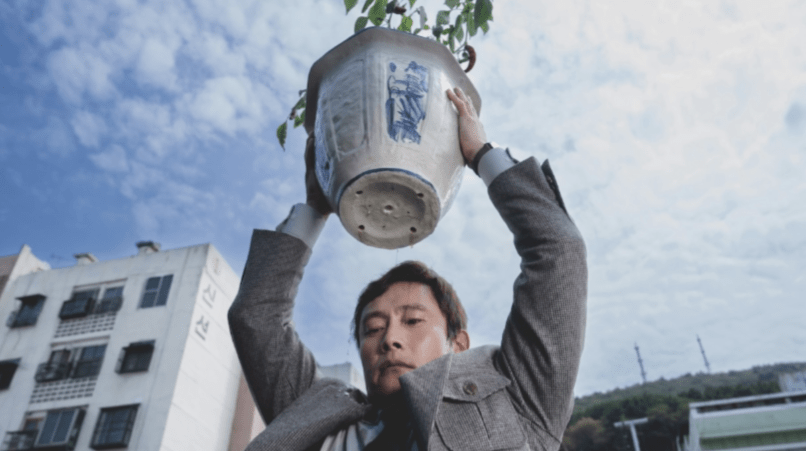
    Lee Byung-hun is Man-soo, a loyal employee for a company making paper, but suddenly and without prior warning, he is made redundant, which jeopardises his entire life as he has to provide for his wife and children at home, he has to be able to keep the house he bought from his family with immense sentimental value, he has to be able to provide to keep his place as the man of the house. Slowly his life starts to get more in danger of losing its worth, and stuff like the children’s two dogs, and his wife’s dancing classes, or Man-soo’s car are in jeopardy. While wealth and material don’t define a man, or come above the unconditional love, it still undermines Man-soo. What doesn’t help is his wife, Mi-ri—played excellently by Son Ye-jin, by the way, I hope her work doesn’t go unnoticed—was a single mother before her and Man-soo met, and while he is a father to both her children in all but blood, there’s a worry about the stability in the relationship, an obligation to prove himself. Mi-ri works at a dental clinic, and her co-worker is constantly trying to undermine Man-soo, at least from his point of view, so it only drives Man-soo further.

    Still, Mi-ri still trusts Man-soo and tries to keep him calm, he promises that he will be employed again in 3 months…. But months add onto each other, and years later, Man-soo still struggles. The only hope he has is a rival paper company, Moon Paper is hiring, and he submits his resume, though he’s completely humiliated in the interview as he’s found in the restrooms after. However, he has been unemployed for years, and he believes he’s a perfect fit, he has no other choice but to forcibly secure the job by eliminating his competition.

    As you can imagine, this is quite the quick decision, to descend to murder over a job, but there are so many factors as I listed previously as to why he would get this desperate. He doesn’t instantly take to killing, and it actually takes him a while to directly kill someone, but his first brush with murder not only resonates with him, but also resonates with the film’s thesis, and its satirical spine.

    His first opponent is an old disgusting man, completely inactive with presumably far more years in unemployment. Park uses the unflattering fried chicken crunches and grease to really convey the sloth of this man, it reminded me of The Substance (2024). In many ways, he is a mirror to Man-soo, especially in his stubborn attitude. When asked about if he should take up other types of careers, the man simply says that he can’t even entertain that idea because “Paper has fed me for 25 years”. At first, it would seem a bit ridiculous but Park’s overall evaluation of society is that jobs are the entire crutch of them and it goes way beyond money, but also respect and pride. Man-soo is equally proud of his career in making paper as he believes it gives his life a grand sense of purpose, but it also allowed him to take control of his life. That being taken away from him unceremoniously, in a brutal way that erases his dedication to that job is a punch in the gut, and it’s hard for Man-soo to handle.

    It’s not a coincidence that between both Man-soo and Mi-ri, and Man-soo’s first attempted victim’s own relationship are both displays of the differing ways men and women deal under stress. The difference is that Man-soo still has a fight in him, and Mi-ri is still dedicated to Man-soo, unlike Ah-ra is to her man, when Man-soo catches her having an affair when he’s there to kill her husband. The strain in their relationship is rooted in his laziness, lack of willingness to be better, and descent in being physically revolting. Man-soo sees a future version of himself in this man, which scares him. Man-soo is unable to actually kill the man himself, and instead it boils down to Ah-ra, which initially attempts to defend her husband, but ultimately becomes the one to kill him as a result of an argument the three have in the chaos of it all. It’s such an interesting scene, not only because of how genuinely funny it is, but I think it’s a perfect depiction of what Man-soo fears; what Park is trying to convey, a society so reliant on jobs is like a house of cards, and it can all come falling down at once. So are you going to let it, like the slothful older man, or will you step up and fight for your family.

    While I’m sympathetic to the powerlessness of the employee in the world of work, and the pride in what you choose to spend most of your life working away at, but the despite Man-soo and the older man being two paths of indefinite unemployment and its effect on men, they’re both stubborn to a fault and that’s the satirical part of it. The refusal to back down from paper even for a little while before stuff gets back to normal, Man-soo won’t even think about doing anything else, and the irony is that there absolutely is another choice in the matter. Instead it speaks on Man-soo’s nature, that he’s able to kill multiple times simply for the sake of his status.

    Mi-ri in contrast is very rational, and is the one that decides what should be cut down on. She is willing to sacrifice what makes her happy for the sake of the family, and she even offers to do more to provide, but Man-soo only seems to be focused on his fears of infidelity. As a result, he’s simply pushing her away; Mi-ri is stronger than that though, despite Man-soo’s doubts.

    Hiding Away in the Greenhouse

    Between No Other Choice and Decision to Leave, I think an interesting and incredibly effective technique is the use of certain natural elements to convey central themes of the movies. In Decision to  Leave, the mountains and the beach were both contrastingly used to demonstrate the vast differences between the two central characters; the mountains representing stability and desire for clarity whereas the sea represents mystery, fluidity and unpredictability. Park’s imagery in that film displays both of these scenes in such a stunning way. No Other Choice seems to have a big affinity with trees. I mean at first you think of it as the literal pun, that Man-soo is literally “axed”, of course his job is situated within an industry that is consistently around trees to create paper. I feel like that’s only the surface level of it though.

    A tree itself is inherently connected to the concept of life itself, rebirth and fertility as well. I suppose the irony is in the fact Man-soo’s job involves literally destroying them, thus killing life. Although, they state that they replant right away, in an artificial sense of what a healthy life is. The concept that you can kill life and simply replace it without any ethical way, just like Man-soo demonstrates in his murder plan. Additionally, a tree can represent stability, strength, wisdom and courage; values a man of the house should have, values that Man-soo believes he has, and has to uphold. The roots of the tree obviously also have a huge link to the family unit, Man-soo has a family to provide for, his connection to trees and staying in the paper industry directly parallels his passion for providing for his family and keeping them together and happy.

    Alternatively, trees as a collective—a forest—can convey a sense of isolation and a general lack of direction. It’s easy to get lost in a forest. The trees tower over you and overwhelm you and ultimately look so similar to each other it’s hard to navigate your way through it. The feeling of isolation, lack of direction, uncertainty in destination is all too true for Man-soo.

    The only sense of stability for Man-soo comes from his greenhouse outside his house. He spends his nights there. More than just simply symbolising his concealment of his crimes, the comfort he finds in his greenhouse are supposed to evoke a sense of peace, tranquility and safety for Man-soo. It’s as if he’s found a checkpoint where he can escape the outside world, because the nature of the real world is confined in a small space close to his family.

    I absolutely love this environmental storytelling and I really hope Park continues down this line because it’s so multifaceted. Not to mention, it’s also a very smart pun with the entire angle of being fired in the first place.

    Accepting Your Powerlessness

    Ultimately, Man-soo’s plan works even if it is irreparably damaging to his psyche. The core of the film, for me at least, is this sense of powerlessness that we have in a world that is dictated by jobs not only through how much money you make but what respect you have as a result of it. Being controlled by a mandated criteria, and while Man-soo takes back this power forcefully, and it could be seen as this big attack on the system, it’s all for nothing as even after winning and getting himself a job in the industry he has passion for, it’s simply a one man job to turn on machines. Aiding AI, isolated in a completely empty factory full of soulless machines. It doesn’t take a genius to see the parallel here, Park doesn’t secretly have a passion for the paper industry; this is an active issue in the film industry!

    The merciless axe, or lack of opportunity, forces people into wars for a role that is slowly being replaced by AI simply for the cost and nothing more. It’s scary and with the whole Tilly Norwood fiasco it is more and more scary as time goes on. While creative industries are a little safer for a bit as there’s resistance, a job like making paper has absolutely no resistance against it. The argument of creativity triumphing is unfortunately not a thing in those kinds of careers. No matter how passionate they are for their craft, it’s simply seen as handy work better handled by robots. The worst part is people in these industries accepting it, only because they’re literally forced into a corner. It’s scary that the film industry may eventually be backed into this same corner.

    I love when a film leaves you thinking long after the credits, and No Other Choice successfully did that. I hope everyone reading this goes and sees this film whenever it releases for you (probably 2026 for the UK, because they hate us!).

    It’s clear how much I loved this film. I admit going in I was excited for it, and then I was also at a film festival so it does absolutely add up in favour of the film you watch, but with time removed from the viewing, I feel confident in my genuine thoughts here. The film isn’t perfect, I felt like it took a little too long to build up to the first incident but it’s hard to overly fault the film for that when I didn’t have an issue with the buildup on its own.

    I wouldn’t rank this as my favourite Park Chan-wook film, but arguably it’s his most accessible I feel like a lot of people will start to get acquainted with him as a result of this film. It’s easily one of the best films of the year. I love a film that is bold, and making a film with a premise that has the potential to be so morbid and dark into genuinely one of the funniest films of the year just shows control of his craft on a different level. Often the film felt slapstick, as if it was a silent movie that had dialogue. The exaggerated movements of Man-soo, the situations he finds himself in.. I won’t spoil but it will undoubtedly give you the same feeling that above the dark meaning of the film, there’s an entertaining comedy, and that just feels cathartic in what it’s trying to say about real life. It gets so absurd sometimes, life is like a comedy. There is no other choice but to laugh.

    Thanks for reading..

  • ‘The Smashing Machine’: A Day Without Pain is Like A Day Without Sunshine

    ‘The Smashing Machine’: A Day Without Pain is Like A Day Without Sunshine

    8th October 2025

    ★★★

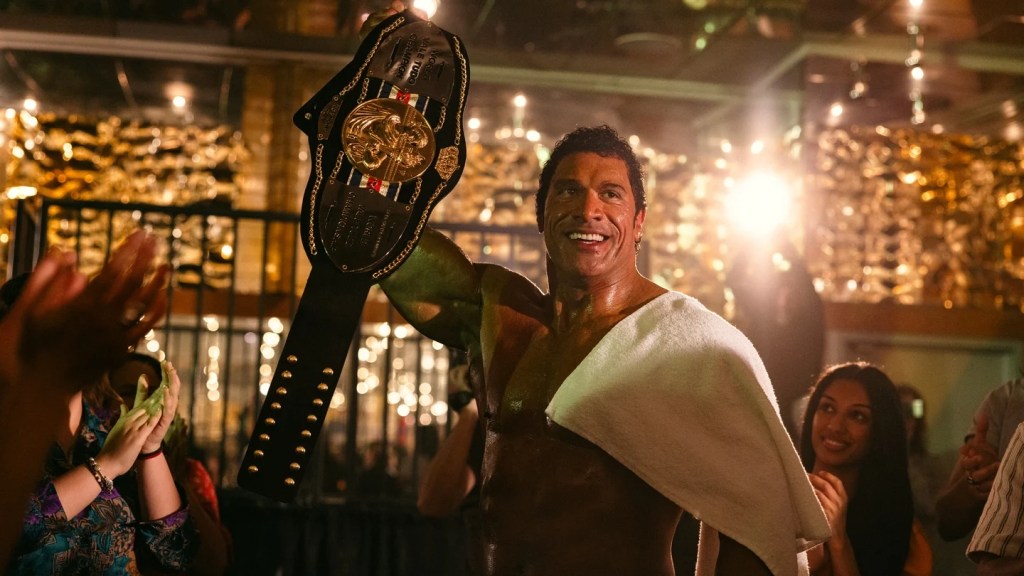
    When The Smashing Machine’s first official still released, and Dwayne “The Rock” Johnson’s look as Mark Kerr was revealed, I remember the disbelief. He was unrecognisable, and instantly it put the film on my radar. But is the film a bold new film from one half of the Safdie Brothers, or is it a vehicle for The Rock’s new career direction?

    In the 2010s, the Benny and Josh Safdie really established themselves as a directing duo to look out for with the 2017 crime thriller, Good Time, a film that also showed the world Robert Pattinson’s acting abilities. A huge part of the reason Good Time was so well regarded was a sense of constant anxiety the film would invoke on the audience. Their follow-up, 2019’s Uncut Gems though, truly cemented their legacy. Starring Adam Sandler in a heavily praised role that played against type for Sandler, the film was even more anxiety-inducing than Good Time. Since 2019, the two hadn’t released another film, until it was announced that the two had parted ways to direct on their own.

    It’s 2025, and both films have premiered, and are coming within 2 months of each other. It’s funny how that worked out, but in a way it really does show us a definitive comparison of the two, and while that’s not what my review is about, as frankly I find it reductive, I think it’s interesting to know what parts of their films as a duo translate into their solo work. In Benny Safdie’s case, he decided to make a film about the obstacles in the life of Mark Kerr in pursuit of being the best in a mixed-martial arts competition. Kerr himself is often referred to as “the smashing machine” due to his persistence and ability to just completely lock in and destroy his opponents, although as someone who didn’t know anything about Mark Kerr going in, the title gave me a different impression of the film’s subtext. Josh Safdie’s solo feature will be a fascinating comparison, Marty Supreme shares the writer for Good Time and Uncut Gems, and it has premiered as I said before, but as it is just one screening nothing is set in stone yet for it. Considering that both films are about sports in one way or another is a really funny coincidence, but it’s instantly apparent there are differences in their styles.

    Cracks in the Rock

    Instantly from the first time it was reported that The Rock was starring in this film, it was pretty obvious the angle Dwayne Johnson was going for. As a film produced by A24, and directed by a Safdie basically right after the biggest failure of his career, Johnson’s ambitions for box office domination were growing stale. His attempted takeover of the DC brand with Black Adam in 2022 left him with his butt on the floor, and quite frankly it was embarrassing considering how badly it flopped after the ego-trip that was the marketing campaign for the film. I was very tired of The Rock as an actor because of his ambition only ever being in pursuit of money and fame, and the performance being purely an afterthought. Arguably, his best performance was his voice work in Moana as Maui for me, and it’s mainly because you could tell he was having fun with it, and it really comes across. Compare that to Netflix’s Red Notice (2021), one of the worst movies I have ever suffered through and there is no fun involved, he wanted a successful Netflix film and that is what he got.

    Black Adam’s failure however has seemed to change Johnson’s approach to film. He has said himself that he realised that box office domination was ultimately an empty pursuit, and to challenge himself and actually try putting in a performance was something he was more interested in. Mind you, this is in the same breath as a Moana remake that keeps Dwayne Johnson in his role as Maui again, but alas.. Johnson has seemingly managed to land a role in a potentially real Scorsese gangster film and so from the outsider’s perspective it’s a little hard to see what the “play” is. I could sit here and tell you he’s only doing all this because he’s in desperate need of an Oscar, a new egotistical mission — but I don’t want to do that. Whether or not that is his intention, it’s of no relation to the integrity of his performance.

    The Smashing Machine truly does show a different side of Dwayne Johnson as an actor. I’m still on the Dave Bautista train, and John Cena continues to impress as Peacemaker, but I will admit I was impressed with Johnson’s performance here. Mark Kerr is portrayed as a man that is willing to abuse his own body in order to be the best. He laments on how much about the high that winning gives him, and he is unbeaten for a while in the movie to the point of his inability to fathom losing as he hasn’t experienced losing. Johnson succeeds in portraying this conflict, his reputation rules his decisions, but there are cracks under the surface, and a lot of this is shown in the scenes behind closed doors with his girlfriend, Dawn, played by Emily Blunt, who is also very good.

    These domestic scenes were the highlight of the film for me. It shows a different side of Mark Kerr for better and for worse. His addiction to fighting pairs with an addiction to opioids, meanwhile his girlfriend Dawn wants to be let in to the other side of Mark’s life that he has kept a big wall around. It results in a lot of argument scenes that get quite intense, and Emily Blunt is absolutely incredible, it also gives Dwayne Johnson an opportunity to cry and shout, the universal best acting signifier obviously. Jokes aside, I appreciated the focus on Mark Kerr’s fallibility and vulnerability, and the film allows him to just run behind the curtain and just cry, which is a focus you don’t see in these types of movies. Instead you see destructive behaviour, and of course Mark has his fair share of destructive responses, and does abuse himself with his addiction to pain medications, he ultimately achieves sobriety pretty early in the film, a bit earlier than expected, and it honestly allows Mark Kerr’s vulnerability to be based on his own issues, his own flaws and insecurities rather than just getting hopelessly high to drown it out. I was surprised by how Dawn (Emily Blunt) ended up being the one to break to the point of having to forcibly be taken away. That pairing is inherently destructive due to Mark’s big indestructible wall that hurts to try and break through, though her own mental health issues, and growing alcohol and drug reliance causes a lot of tension for Mark as he is really trying to be better and be the strong and undefeated by opioids and yet Dawn is invertedly throwing it back in his face.

    I’ve also got to hand it to the makeup department as Johnson did initially look unrecognisable. In action, you can tell it’s him through the way he speaks and generally carries himself, but I never felt like I was just watching The Rock playing himself, and a lot of that is in the makeup that completely changes his face, and I found that really impressive.

    I Need You to Let Me In

    While the performances and the focus on the humanity and vulnerability of Mark Kerr were big strengths of the film for me, everything else left me a little underwhelmed. The Smashing Machine ends up feeling pretty surface level in the themes it explores, and parts of the plot.

    The Smashing Machine feels like it’s a documentary of Mark Kerr’s life, and I don’t think that’s inherently a bad thing, but the core of the plot is a wrestling tournament that doesn’t have well established stakes, that ultimately feels weightless when all is said and done. This would be fine if the film had a lot of substance in its subtext, being a character study that makes it that any fight would have you on the edge of your seat. The Iron Claw (2023) directed by Sean Durkin is a great example of this, the film is devastating and the stakes are extremely high based entirely on how the characters are built up. Mark Kerr is decently developed as I said before, and I still maintain that, but major parts of his development feel skimmed over. For example, his struggle with opioid addiction, his collapse is very random, and it happens off-screen. His sobriety journey then happens almost directly after but we don’t really see it, and it feels like that aspect of his life is just over. It’s a slippery slope complaining about something like this because Mark Kerr is still with us today and he actually did recover and become better, I’m not asking for the film to make up how he was, but rather not make these obstacles feel so insignificant to the tension of the story. Because we barely see either of these aspects, we don’t really feel like we’ve bonded to Mark and are instead being told about it. Hence the documentary comparison — it’s a large part of why biopics fail, because they feel more concerned about adapting their Wikipedia page. The Smashing Machine does choose to focus on a specific period of time, and it wants to go into Mark Kerr as a person and his struggle, but it doesn’t go beyond the surface level.

    For example, Mark’s abuse of opioids, addiction to pain, and even a clear scene that shows two cars destroying each other for the entertainment of others. These all feel like they’d contribute to this concept of Mark Kerr feeling inhuman, as if he is a machine made to deal and take pain; the title of the film equally adding to this. I am aware of the fact the title is just his own title in the ring given by others and he took it up, but arguably that’s why it could’ve been a bigger focus here because it’s an active aspect of Mark Kerr by his own admission. There’s so many interesting ways Safdie could’ve shown Mark Kerr’s feeling of being a machine vs being a human, and while I loved the humanity aspects of the film, the machine side is glossed over way too quickly in favour of showing us the tournament. There are certainly aspects of the machine aspect as I said, with the destruction derby parallel, even the broken plate that’s said to be more beautiful glued back together, but it feels a bit shallow when vital aspects to that dichotomy are skimmed over.

    It ultimately leaves the film feeling a little pointless. It didn’t feel like it wanted to say anything, and I don’t always agree that films need to say something, but arguably what’s the point of watching this over a well-made documentary if it’s not willing to use the medium of film to portray things that can’t be done in a documentary in the same way. It left me ironically wanting to be let in, but I was at a distance.

    Despite that, the film was still well made, I loved the performances and I did like the vulnerability of Mark Kerr, but I left the cinema feeling cheated out of a vastly more interesting take of this same movie. Though Benny Safdie’s next solo project is something I will still be keeping an eye out for as what works here really does work for me. The Smashing Machine is a good film that could’ve been great.

    Thanks for reading.

  • ‘One Battle After Another’: Observing the Next Generation of Fighting

    ‘One Battle After Another’: Observing the Next Generation of Fighting

    1st October 2025

    ★★★★★

    Paul Thomas Anderson’s almost 30-year filmography has culminated in his first “blockbuster”, but more importantly, his take on Thomas Pynchon’s Vineland — An adaptation decades in the making, according to PTA.

    Note: I will be discussing spoilers, so please watch the film before reading. Trust me, it’s worth it.

    To preface…

    In 2021, Licorice Pizza’s release inspired me to catch up on Paul Thomas Anderson. As a blooming film enthusiast, aspiring critic, I had heard so much about him. A clear favourite among the film community, and I’ll admit I had a bit of FOMO. At the time I had enjoyed Licorice Pizza enough, and especially appreciated the passion you could feel seeping through the rose-tinted goggles of California in the 70s, a clear dedication to his past and his own nostalgia. What fascinated me most was actually the name; what the hell is a “Licorice Pizza” anyway?! Well, turns out it’s not actually that complicated, and apparently it was slang for vinyl records. However, I think that’s fascinating how slang terms can just completely fade from existence, and can only come back to any kind of relevance with a director like Paul Thomas Anderson’s nostalgic musings.

    Licorice Pizza is a pretty breezy film. It doesn’t exactly take itself too seriously, and it is at its very core more of a hangout movie, perhaps a coming-of-age. I read it as a portrait, but considering the output of PTA across the 2010s, it was potentially misleading to the kind of auteur he actually is. That’s not to say (as others would) that the film is a bad one, but once you dive into his other films, a very different image is painted for you and I had that revelation pretty quickly after as I made my way through his filmography. The remainder of his filmography can be split between pre-Punch-Drunk Love and post-Punch-Drunk Love. Believe it or not, that film was the first to build up PTA’s own defined style. As much as I adore both Magnolia and Boogie Nights, they are products of a younger filmmaker with heavy reverence for his idols, in specific Robert Altman, and to a lesser extent, Martin Scorsese. None of this is to say a filmmaker taking heavy inspiration from a peer is to a fault; art is about building upon your peers and I believe it’s important to do so, but eventually forming your own style is what will make the difference between a great filmmaker, and an important auteur. Paul Thomas Anderson, in my mind, is one of the most important auteurs of our generation, and his latest film, One Battle After Another, I’d argue is one of the most important films he’s ever made.

    Long tangent aside, what is the importance of the preamble? Well arguably we exist in a third era of Paul Thomas Anderson now. At first, his films were derived lovingly from his peers, then he came into his own with diverse and complex stories with characters prioritised, to the detriment of some as they are in desperate search for “the message”, even if that message can be found if you take time to think and evaluate what you’ve watched. It took me a second watch of Phantom Thread, to “get” it. His films say so much without a word. Ironic that a film like Magnolia of his early career is the exact opposite effect, and yet with Phantom Thread, they make up my top 2 films from him. Anderson’s maximalist interwoven tale of unrelated residents ultimately experiencing something ridiculous to distract from their broken lives contrasts his subtle romance turned bitter of a difficult rich dressmaker marrying a waitress who turns out to be his match in a bid for power. Ultimately, these films are about characters at the end of the day and it’s their strength, but Magnolia tells you its message pretty clearly. Fast-forward to One Battle After Another, Anderson’s smaller budget average is turned on its head as he makes his first “blockbuster”, as the budget exceeds $100M. What has changed? A lot and not much in many ways. One Battle After Another is simultaneously an American epic and interpersonal character drama bathed in a hellish setting that is the result of a broken America that mirrors the real world in some disturbing ways.

    On the surface, One Battle After Another would seem dreary, pessimistic and PTA’s confident, well-made “told ya so” to moviegoers. However, because we are in the hands of PTA, it isn’t as simple as that. One Battle After Another is a call for action via optimism for future generations..

    The Revolution Will Not Be Televised

    It doesn’t take a genius to figure out the parallels to real life that are being portrayed on screen. Timely is an understatement, but prophetic feels more accurate. One Battle was wrapped a year back, and everything in the film is not reactionary to any events, but are instead reading the room of the time. As aforementioned, Vineland is cited as the work being adapted for this film, but comparatively, these are vastly different pieces of fiction. Anderson adapted Vineland to the modern day, and through that changed a lot of the commentary to fit. Vineland was about Reagan-era America, and was concerned with other aspects of the zeitgeist causing disruption or fear, even screens themselves. I haven’t read the book, but I know people who have and they tell me that One Battle and Vineland are barely like each other, and yet there is a very distinctive Pynchonian feel to the film. Apply the civil unrest of the modern day to a story of revolting against the state of America and that’s what Anderson’s intention was. It also explains why this adaptation was such a long time coming for Anderson, as it wasn’t as simple as just taking stuff from the pages to the screen.

    Throughout all of fiction, there are tales that last generations. Stories that need to be passed on because their meaning and their intention is important, and Anderson’s interpretation of Vineland is one of them. Even taking away this year, or last month for that matter, this decade has been a tough one for the entire planet, and there is a lot of tension between countries, fear of a fascist uprising and general pessimism in human nature itself, and America is in the center of it all. Just like how the book was about how Ronald Reagan’s re-election affected the country, One Battle is a response to the early 2020s, and the tensions related to that, with the end of Trump’s first term, the controversial involvement in both Russia-Ukraine and Israel-Palestine relations and the treatment of immigrants. The first 30 minutes of One Battle covers so much and ultimately ends pessimistically. The French ’75 organisation we are meant to align with are shown as unnecessarily violent, selfish and ultimately pointless as Perfidia Beverly Hills, played by Teyana Taylor, shows us. After the first declaration of war, the French ’75 blow up buildings, take out the power in the city.. all in the name of saving the world. Anderson centers so much of this section around Perfidia because she’s this overcorrection to the issues of the film. I’ve seen many say it feels pointless to show the protagonists being involved in something so senselessly violent as a meaningful way to fix the world, but Perfidia isn’t painted as overly sympathetic.

    A huge aspect of this portion of the film is Perfidia’s relationship with Bob, or ‘Pat’ at the time, played by Leonardo DiCaprio, and Colonel Steve Lockjaw played by Sean Penn. Teyana Taylor plays Perfidia well, as this very powerful, dynamite woman that pursues her strong beliefs and knows her worth, and it’s initially displayed in her relationship with Bob which she seems to completely rule over him, and she has a strong sexual urge, even asking to have sex with Bob while a detonator is about to go off. She lives life on the edge and makes no apologies. Her relationship with Lockjaw is even more fascinating, displaying power dynamics. Perfidia is stumped by Lockjaw as almost her exact opposite on the spectrum, and it’s what attracts her to him. She wants to mess with him, she wants to be in charge of him, as her sexual power over him is how she feels she can get ahead in the world, it’s what she believes is her advantage. When she’s caught planting a bomb in a courthouse, Lockjaw lets her go as long as she gives him something in return. That exchange of power through a sexual desire only driven through power dynamics is so fascinating, and you can tell that both of them are people who are tripping on power, and as radically opposite as possible.

    Suddenly, Perfidia is pregnant, and as soon as she gives birth she instantly has this jealousy for her own daughter, a jealousy that she is no longer the object of attention for Bob, her revolution, her power trip, her radical movement is no longer important for Bob, and he instead has dedicated himself to looking after his daughter, but Perfidia can’t accept that, she has implied postpartum depression, and her struggle to connect with her own daughter leads her to put herself first leading to the operation that cost her family all in the name of some revolution. However, she manages to save herself through telling Lockjaw the names of her associates, forcing them into hiding, including her husband and her daughter, she chooses not to see again, and potentially sentencing them to death if necessary. Such an interesting character, because she is fully a terrible person, but she only really appears in the first 30 minutes and is never physically seen again, but arguably her character speaks a lot to what the ultimate thesis of the film is; the next generation’s interpretation of how to fix the world. Perfidia failed and in the film, she acknowledges it, but she wonders if her daughter is trying too, and if she’s doing better. But equally, her actions don’t define her daughter’s life, which is proven by Willa (Chase Infiniti). Yet the section ends with Perfidia’s voicing over a time skip with, “16 years have passed, and nothing has changed”.

    The Battle of Baktan Cross

    Perfidia’s mother tells Bob that he’s not a good fit for her daughter, that he’s not cut out for this revolution stuff and in many ways this film goes out of its way to prove that, but not necessarily to his detriment. Bob is a very inactive protagonist throughout; in the French ’75 sequence he shows up late and isn’t sure what to do until he is told, and then within the main part of the film, he is always one step behind. Bob’s role in the story isn’t about being a leader, being a revolutionary or even being competent, but rather he is a Dad. He is always there for Willa and even in times where he’s physically unable to protect her or he’s just behind the curve, he will be there when it counts to comfort her and make sure she’s alright, but behind that is a paranoid man that has fried his brain with weed. Leonardo DiCaprio does this role incredibly well, I mean his comedic roles have always been my favourite of his, and he’s really going for it here. In contrast to Perfidia’s strong will and dangerous narcissism, Bob is far more calm and isn’t the leading type, rather he feels pretty content amongst the crowd, waiting for orders. While he wants to fix the world, he’s accepted that he’s unable to sometimes, and puts his family first.

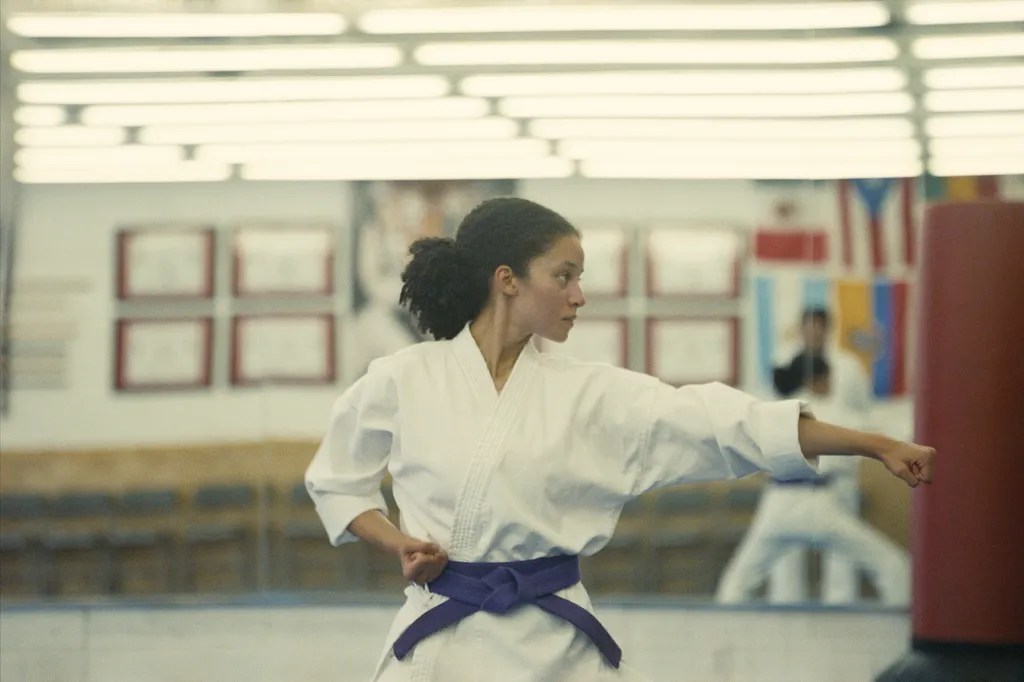
    However, he teaches his daughter Willa what she needs to know in case of emergency, and Willa takes karate classes showing how Bob’s approach to the revolution, and to saving the world was instead through raising his daughter and teaching her how to face the world for herself, allowing her to be in control. His actions form the woman she becomes and the actions she takes in the film are never a direct result of Bob, but instead are actions she takes based on what she’s been taught. Bob’s stupidity and incompetency leads him one step behind Willa at all points, but allows him to comfort his daughter and give her love after she’s dealt with the world. Bob exemplifies the passing of the torch between generations in order to give us hope for our future.

    And in contrast to Perfidia’s comment on 16 years of no change, Bob discovers a revolution that has a different approach compared to the French ’75. Willa’s karate teacher Sensei Sergio played by Benicio Del Toro offers Bob a helping hand and invites him to his secret “Latino Harriet Tubman situation” in Baktan Cross where a riot is taking place on the streets with the police fighting fire with fire, Sergio’s shop has a community full of people. It’s a safe haven filled with community, love and care and it radiates throughout the scene as you see the respect they all have for each other. Sergio’s approach in comparison to Perfidia displays a palpable difference in allegiance; where the French ’75 was ultimately a narcissistic venture, Sergio’s underground network is selfless and puts those in danger first rather than as an afterthought. As her instructor and mentor, Sensei Sergio’s compassion and morals rub off on Willa too.

    Who Are You?

    Willa is a culmination of everyone who has influenced her, but is your blood relation enough to define your actions, even if you never knew them?

    Lockjaw’s motivation is to take Willa captive, but she doesn’t know why or who he even is. The truth is, Lockjaw is a vile man.. beyond just his actions, Penn nails it with the way he walks and moves his lips makes you feel uncomfortable and you can tell the kind of person he is right away. I mean that name alone cements it, you’re not called Colonel Lockjaw and a good guy at the same time. His actions are a result of an interview he partakes in at the start of the film where he is applying for the Christmas Adventurers’ Club, a white supremacist group that wants to purify America, however to join he can’t have had any relationship with a person of colour, and obviously his relationship with Perfidia was clearly important to him. Worse yet, Perfidia got pregnant not long after their affair, and Lockjaw doesn’t want to take any risks so he makes an excuse to have the military brought down to Baktan Cross after forcing an ex-member to give away the location and names of Bob and Willa.

    I have somehow managed to neglect mentioning it so far, but Jonny Greenwood’s score is just phenomenal, although I can’t say that surprised me as he is probably my favourite working composer, but his score for One Battle After Another is special in particular due to the way it can completely dominate a scene and define it. It tells a story of its own. Lockjaw manages to find the hideout and catch Willa, the frame of an empty spacious church hall with Willa one side, and Lockjaw sat on a chair on the other side builds up to the swelling of the score that plays a few times across the film, but the crescendo here specifically is so deeply impactful. It’s so loud, it’s overwhelming and scary and feels like an ultimate confrontation. It turns out to be just that as Lockjaw takes the paternity test, and the results show that Willa is his. This is one of the most powerful scenes of the movie, as Lockjaw tells Willa that being a part of the Christmas Adventurers’ Club is a higher honour than being her father. Radically opposite to Perfidia, and yet both share a higher importance to what they believe is a higher calling compared to their own flesh and blood. Chase Infiniti blows me away in this scene with the devastation she has in her face, but also disbelief and disgust. But she isn’t defined by who her father actually is, she was never defined by who her mother was as both were never there for her. The only person who has always been there for her has always been Bob and always will be Bob. Because of Bob she is able to eventually save herself and handle herself, eventually reuniting with him.

    Ultimately, she reads that letter from her mother, one she didn’t know about, and as I said earlier it is so vital to the thesis of the film, and a result of her reading this letter and finally having something real from her mother instead of this fake story of her being a fallen hero, helps Willa really choose what she wants to do, and that’s helping save the world like her mother tried, but failed. However, she isn’t her mother, Willa is her own person defined by those who raised her and not who she’s blood related to, and the ways she can help save the world are through different more effective ways. Of course, Bob is still there supporting her and helping her out but letting her go off on her own and be her own girl instead of sheltering her away out of fear. Anderson instills confidence in younger generations to learn from the mistakes of previous generations. The best way to save the world is to teach future generations the issues and support them so that change can actually happen instead of being caught in a vicious cycle of violence and narcissism.

    There is genuinely nothing more vindicating and optimistic than the ending with the “American Girl” needle drop truly instilling confidence and hope in our generation and those who come afterwards.

    Ocean Waves

    All that messaging and character work is in service of PTA’s first action film, and One Battle is one of the most thrilling films I’ve seen with the expected incredible direction from Anderson. It juggles with a lot of themes, a lot of characters and subplots, and there are certain characters I wish could’ve been utilised more, I think so much of One Battle’s strength is in what it keeps under the surface for those paying attention to understand. The film never says much about Perfidia’s postpartum depression or how she feels about her daughter in reality, but PTA contrasts a scene of Perfidia, Bob and Willa in their bed as repeated twice in two opposite ends of the film, with one showing Bob as the nurturing type where Perfidia is cold, but during the letter from Perfidia, she appears more nurturing. It is what repositioned my thoughts on Perfidia as a person, as which version of this scene was the real one? The truth is it doesn’t matter because even if she didn’t act this way, she clearly had it internalised. She punished herself by choosing to give up motherhood and a family because she felt she didn’t deserve it, and in a way it could be a major reason as to why she threw herself at what was her biggest foe.

    The pacing of One Battle is truly insane after watching it twice, it doesn’t ever feel like it’s approaching 3 hours long, and I still can’t understand why. Maybe it’s because it is stacked with things constantly happening and everything feeling necessary with no scenes that drag. It’s truly a perfect edit in my mind, and I really appreciated the usage of fades as a really underrated way to transition a scene and also pair two scenes’ image onto each other to create meaning.

    But you can’t talk about One Battle After Another without addressing the iconic road. Anderson’s use of roads, the desert and hills like ocean waves is astounding. Undoubtedly the best car chase I’ve seen in a film by virtue of how genuinely rollercoaster-like it felt. The camera follows the road as if we are actually there, and the cars are just far enough away from each other that each time they approach a hill, their view of what’s behind and in front is compromised and each time you can see properly again it just adds so much to the tension and thrill of the scene. There is a reason the scene has been talked about so much.

    There’s honestly a lot more I could talk about but I feel like I talked about everything that could fit into a section instead of being random. It’s just a monumental film and it feels like a true culmination of Paul Thomas Anderson’s previous work while being something completely unlike what’s come before it. As I said earlier, I do believe this is the start of a new era of PTA’s filmography and that’s because PTA is still young in director years, and has so much more left in him that it is nothing but exciting, and to be trusted with an expensive film that could’ve easily not resonated in this climate is a great sign. This is easily my favourite film of the year so far and one of the best films PTA has made, and I don’t say that lightly.

    Ultimately, PTA’s earnest optimism but not naivety to the state of the world is exactly what people need, and maybe if we trust future generations and teach them the right way, change can come and there may still be hope. But even in the worst of times, even when the world is a hell-hole, love prevails and family matters, as corny as that sounds. Bob’s love for Willa is unconditional despite blood, and that’s the most beautiful thing.

    From here on out, it’s one battle after another.