
21st October 2025
★★★★½
A week ago, I was at the Royal Festival Hall because I attended an early screening for No Other Choice at the London Film Festival.
I jumped at the chance as such a huge fan of Park Chan-wook, one of the boldest, best auteurs of our time. I just had to be sure I saw a new film from him as soon as possible, especially considering how most international films come out early the following year in the UK. Decision to Leave (2022) was the film that got me hooked on the Wook (remind me to never say that again), I had heard of how amazing he was, but I hadn’t actually seen his big masterpieces– namely, Oldboy (2003) and The Handmaiden (2016)– but something about the buzz for Decision to Leave, and especially the trailer told me something about that film in particular, but also Park as a director. I have yet to see a film match the insane directorial feat.
He makes these fucked up odysseys that blur the line between genres, but at its core, all of his films are hyper focused on the psyche of their characters. Oldboy has one of the most fucked up protagonists of all time, but he is so well fleshed out and built up over the course of the film that you truly feel his pain and disgust, Tang Wei’s Seo-rae is an enigma that sends Hae-jun into an obsessive lustful state, and now in No Other Choice, Man-soo is led to murder after years of unemployment.
Between the lines of these films, there is some sense of humour in it, but in No Other Choice, Park Chan-wook goes full on black comedy. Scratch that, he essentially made a slapstick comedy… in a good way..
Paper Has Fed Me for 25 Years
Lee Byung-hun is Man-soo, a loyal employee for a company making paper, but suddenly and without prior warning, he is made redundant, which jeopardises his entire life as he has to provide for his wife and children at home, he has to be able to keep the house he bought from his family with immense sentimental value, he has to be able to provide to keep his place as the man of the house. Slowly his life starts to get more in danger of losing its worth, and stuff like the children’s two dogs, and his wife’s dancing classes, or Man-soo’s car are in jeopardy. While wealth and material don’t define a man, or come above the unconditional love, it still undermines Man-soo. What doesn’t help is his wife, Mi-ri—played excellently by Son Ye-jin, by the way, I hope her work doesn’t go unnoticed—was a single mother before her and Man-soo met, and while he is a father to both her children in all but blood, there’s a worry about the stability in the relationship, an obligation to prove himself. Mi-ri works at a dental clinic, and her co-worker is constantly trying to undermine Man-soo, at least from his point of view, so it only drives Man-soo further.
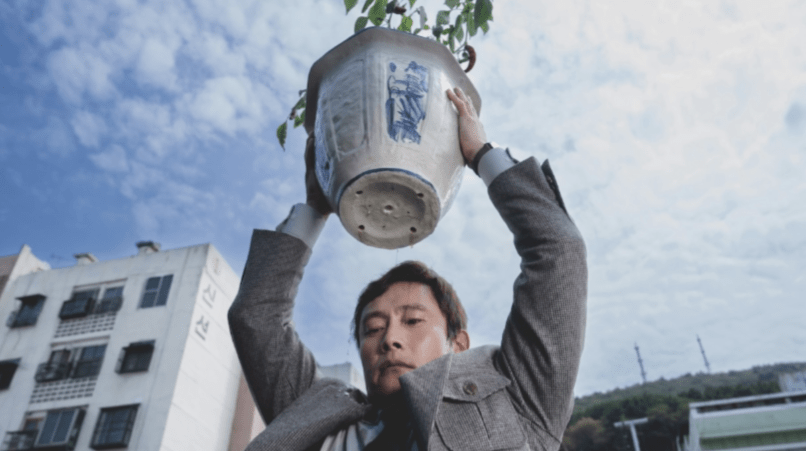
Still, Mi-ri still trusts Man-soo and tries to keep him calm, he promises that he will be employed again in 3 months…. But months add onto each other, and years later, Man-soo still struggles. The only hope he has is a rival paper company, Moon Paper is hiring, and he submits his resume, though he’s completely humiliated in the interview as he’s found in the restrooms after. However, he has been unemployed for years, and he believes he’s a perfect fit, he has no other choice but to forcibly secure the job by eliminating his competition.
As you can imagine, this is quite the quick decision, to descend to murder over a job, but there are so many factors as I listed previously as to why he would get this desperate. He doesn’t instantly take to killing, and it actually takes him a while to directly kill someone, but his first brush with murder not only resonates with him, but also resonates with the film’s thesis, and its satirical spine.
His first opponent is an old disgusting man, completely inactive with presumably far more years in unemployment. Park uses the unflattering fried chicken crunches and grease to really convey the sloth of this man, it reminded me of The Substance (2024). In many ways, he is a mirror to Man-soo, especially in his stubborn attitude. When asked about if he should take up other types of careers, the man simply says that he can’t even entertain that idea because “Paper has fed me for 25 years”. At first, it would seem a bit ridiculous but Park’s overall evaluation of society is that jobs are the entire crutch of them and it goes way beyond money, but also respect and pride. Man-soo is equally proud of his career in making paper as he believes it gives his life a grand sense of purpose, but it also allowed him to take control of his life. That being taken away from him unceremoniously, in a brutal way that erases his dedication to that job is a punch in the gut, and it’s hard for Man-soo to handle.
It’s not a coincidence that between both Man-soo and Mi-ri, and Man-soo’s first attempted victim’s own relationship are both displays of the differing ways men and women deal under stress. The difference is that Man-soo still has a fight in him, and Mi-ri is still dedicated to Man-soo, unlike Ah-ra is to her man, when Man-soo catches her having an affair when he’s there to kill her husband. The strain in their relationship is rooted in his laziness, lack of willingness to be better, and descent in being physically revolting. Man-soo sees a future version of himself in this man, which scares him. Man-soo is unable to actually kill the man himself, and instead it boils down to Ah-ra, which initially attempts to defend her husband, but ultimately becomes the one to kill him as a result of an argument the three have in the chaos of it all. It’s such an interesting scene, not only because of how genuinely funny it is, but I think it’s a perfect depiction of what Man-soo fears; what Park is trying to convey, a society so reliant on jobs is like a house of cards, and it can all come falling down at once. So are you going to let it, like the slothful older man, or will you step up and fight for your family.
While I’m sympathetic to the powerlessness of the employee in the world of work, and the pride in what you choose to spend most of your life working away at, but the despite Man-soo and the older man being two paths of indefinite unemployment and its effect on men, they’re both stubborn to a fault and that’s the satirical part of it. The refusal to back down from paper even for a little while before stuff gets back to normal, Man-soo won’t even think about doing anything else, and the irony is that there absolutely is another choice in the matter. Instead it speaks on Man-soo’s nature, that he’s able to kill multiple times simply for the sake of his status.
Mi-ri in contrast is very rational, and is the one that decides what should be cut down on. She is willing to sacrifice what makes her happy for the sake of the family, and she even offers to do more to provide, but Man-soo only seems to be focused on his fears of infidelity. As a result, he’s simply pushing her away; Mi-ri is stronger than that though, despite Man-soo’s doubts.
Hiding Away in the Greenhouse
Between No Other Choice and Decision to Leave, I think an interesting and incredibly effective technique is the use of certain natural elements to convey central themes of the movies. In Decision to Leave, the mountains and the beach were both contrastingly used to demonstrate the vast differences between the two central characters; the mountains representing stability and desire for clarity whereas the sea represents mystery, fluidity and unpredictability. Park’s imagery in that film displays both of these scenes in such a stunning way. No Other Choice seems to have a big affinity with trees. I mean at first you think of it as the literal pun, that Man-soo is literally “axed”, of course his job is situated within an industry that is consistently around trees to create paper. I feel like that’s only the surface level of it though.
A tree itself is inherently connected to the concept of life itself, rebirth and fertility as well. I suppose the irony is in the fact Man-soo’s job involves literally destroying them, thus killing life. Although, they state that they replant right away, in an artificial sense of what a healthy life is. The concept that you can kill life and simply replace it without any ethical way, just like Man-soo demonstrates in his murder plan. Additionally, a tree can represent stability, strength, wisdom and courage; values a man of the house should have, values that Man-soo believes he has, and has to uphold. The roots of the tree obviously also have a huge link to the family unit, Man-soo has a family to provide for, his connection to trees and staying in the paper industry directly parallels his passion for providing for his family and keeping them together and happy.
Alternatively, trees as a collective—a forest—can convey a sense of isolation and a general lack of direction. It’s easy to get lost in a forest. The trees tower over you and overwhelm you and ultimately look so similar to each other it’s hard to navigate your way through it. The feeling of isolation, lack of direction, uncertainty in destination is all too true for Man-soo.

The only sense of stability for Man-soo comes from his greenhouse outside his house. He spends his nights there. More than just simply symbolising his concealment of his crimes, the comfort he finds in his greenhouse are supposed to evoke a sense of peace, tranquility and safety for Man-soo. It’s as if he’s found a checkpoint where he can escape the outside world, because the nature of the real world is confined in a small space close to his family.
I absolutely love this environmental storytelling and I really hope Park continues down this line because it’s so multifaceted. Not to mention, it’s also a very smart pun with the entire angle of being fired in the first place.
Accepting Your Powerlessness
Ultimately, Man-soo’s plan works even if it is irreparably damaging to his psyche. The core of the film, for me at least, is this sense of powerlessness that we have in a world that is dictated by jobs not only through how much money you make but what respect you have as a result of it. Being controlled by a mandated criteria, and while Man-soo takes back this power forcefully, and it could be seen as this big attack on the system, it’s all for nothing as even after winning and getting himself a job in the industry he has passion for, it’s simply a one man job to turn on machines. Aiding AI, isolated in a completely empty factory full of soulless machines. It doesn’t take a genius to see the parallel here, Park doesn’t secretly have a passion for the paper industry; this is an active issue in the film industry!
The merciless axe, or lack of opportunity, forces people into wars for a role that is slowly being replaced by AI simply for the cost and nothing more. It’s scary and with the whole Tilly Norwood fiasco it is more and more scary as time goes on. While creative industries are a little safer for a bit as there’s resistance, a job like making paper has absolutely no resistance against it. The argument of creativity triumphing is unfortunately not a thing in those kinds of careers. No matter how passionate they are for their craft, it’s simply seen as handy work better handled by robots. The worst part is people in these industries accepting it, only because they’re literally forced into a corner. It’s scary that the film industry may eventually be backed into this same corner.
I love when a film leaves you thinking long after the credits, and No Other Choice successfully did that. I hope everyone reading this goes and sees this film whenever it releases for you (probably 2026 for the UK, because they hate us!).
It’s clear how much I loved this film. I admit going in I was excited for it, and then I was also at a film festival so it does absolutely add up in favour of the film you watch, but with time removed from the viewing, I feel confident in my genuine thoughts here. The film isn’t perfect, I felt like it took a little too long to build up to the first incident but it’s hard to overly fault the film for that when I didn’t have an issue with the buildup on its own.
I wouldn’t rank this as my favourite Park Chan-wook film, but arguably it’s his most accessible I feel like a lot of people will start to get acquainted with him as a result of this film. It’s easily one of the best films of the year. I love a film that is bold, and making a film with a premise that has the potential to be so morbid and dark into genuinely one of the funniest films of the year just shows control of his craft on a different level. Often the film felt slapstick, as if it was a silent movie that had dialogue. The exaggerated movements of Man-soo, the situations he finds himself in.. I won’t spoil but it will undoubtedly give you the same feeling that above the dark meaning of the film, there’s an entertaining comedy, and that just feels cathartic in what it’s trying to say about real life. It gets so absurd sometimes, life is like a comedy. There is no other choice but to laugh.
Thanks for reading..
 Newton's Law
Leave a comment