
1st October 2025
★★★★★
Paul Thomas Anderson’s almost 30-year filmography has culminated in his first “blockbuster”, but more importantly, his take on Thomas Pynchon’s Vineland — An adaptation decades in the making, according to PTA.
Note: I will be discussing spoilers, so please watch the film before reading. Trust me, it’s worth it.
Hello, and welcome to the first blog on the new site, Newton’s Law! I’ve got big hopes and ambitions for this site, but more importantly, it’s a way I can talk about anything film I want the world to hear.. even if it’s in a format very few will actually see! Still, to put my thoughts out there is what matters, and I will use the site to cover both reviews of new films, older films and anything really.
To preface…
In 2021, Licorice Pizza’s release inspired me to catch up on Paul Thomas Anderson. As a blooming film enthusiast, aspiring critic, I had heard so much about him. A clear favourite among the film community, and I’ll admit I had a bit of FOMO. At the time I had enjoyed Licorice Pizza enough, and especially appreciated the passion you could feel seeping through the rose-tinted goggles of California in the 70s, a clear dedication to his past and his own nostalgia. What fascinated me most was actually the name; what the hell is a “Licorice Pizza” anyway?! Well, turns out it’s not actually that complicated, and apparently it was slang for vinyl records. However, I think that’s fascinating how slang terms can just completely fade from existence, and can only come back to any kind of relevance with a director like Paul Thomas Anderson’s nostalgic musings.
Licorice Pizza is a pretty breezy film. It doesn’t exactly take itself too seriously, and it is at its very core more of a hangout movie, perhaps a coming-of-age. I read it as a portrait, but considering the output of PTA across the 2010s, it was potentially misleading to the kind of auteur he actually is. That’s not to say (as others would) that the film is a bad one, but once you dive into his other films, a very different image is painted for you and I had that revelation pretty quickly after as I made my way through his filmography. The remainder of his filmography can be split between pre-Punch-Drunk Love and post-Punch-Drunk Love. Believe it or not, that film was the first to build up PTA’s own defined style. As much as I adore both Magnolia and Boogie Nights, they are products of a younger filmmaker with heavy reverence for his idols, in specific Robert Altman, and to a lesser extent, Martin Scorsese. None of this is to say a filmmaker taking heavy inspiration from a peer is to a fault; art is about building upon your peers and I believe it’s important to do so, but eventually forming your own style is what will make the difference between a great filmmaker, and an important auteur. Paul Thomas Anderson, in my mind, is one of the most important auteurs of our generation, and his latest film, One Battle After Another, I’d argue is one of the most important films he’s ever made.
Long tangent aside, what is the importance of the preamble? Well arguably we exist in a third era of Paul Thomas Anderson now. At first, his films were derived lovingly from his peers, then he came into his own with diverse and complex stories with characters prioritised, to the detriment of some as they are in desperate search for “the message”, even if that message can be found if you take time to think and evaluate what you’ve watched. It took me a second watch of Phantom Thread, to “get” it. His films say so much without a word. Ironic that a film like Magnolia of his early career is the exact opposite effect, and yet with Phantom Thread, they make up my top 2 films from him. Anderson’s maximalist interwoven tale of unrelated residents ultimately experiencing something ridiculous to distract from their broken lives contrasts his subtle romance turned bitter of a difficult rich dressmaker marrying a waitress who turns out to be his match in a bid for power. Ultimately, these films are about characters at the end of the day and it’s their strength, but Magnolia tells you its message pretty clearly. Fast-forward to One Battle After Another, Anderson’s smaller budget average is turned on its head as he makes his first “blockbuster”, as the budget exceeds $100M. What has changed? A lot and not much in many ways. One Battle After Another is simultaneously an American epic and interpersonal character drama bathed in a hellish setting that is the result of a broken America that mirrors the real world in some disturbing ways.
On the surface, One Battle After Another would seem dreary, pessimistic and PTA’s confident, well-made “told ya so” to moviegoers. However, because we are in the hands of PTA, it isn’t as simple as that. One Battle After Another is a call for action via optimism for future generations..

The Revolution Will Not Be Televised
It doesn’t take a genius to figure out the parallels to real life that are being portrayed on screen. Timely is an understatement, but prophetic feels more accurate. One Battle was wrapped a year back, and everything in the film is not reactionary to any events, but are instead reading the room of the time. As aforementioned, Vineland is cited as the work being adapted for this film, but comparatively, these are vastly different pieces of fiction. Anderson adapted Vineland to the modern day, and through that changed a lot of the commentary to fit. Vineland was about Reagan-era America, and was concerned with other aspects of the zeitgeist causing disruption or fear, even screens themselves. I haven’t read the book, but I know people who have and they tell me that One Battle and Vineland are barely like each other, and yet there is a very distinctive Pynchonian feel to the film. Apply the civil unrest of the modern day to a story of revolting against the state of America and that’s what Anderson’s intention was. It also explains why this adaptation was such a long time coming for Anderson, as it wasn’t as simple as just taking stuff from the pages to the screen.
Throughout all of fiction, there are tales that last generations. Stories that need to be passed on because their meaning and their intention is important, and Anderson’s interpretation of Vineland is one of them. Even taking away this year, or last month for that matter, this decade has been a tough one for the entire planet, and there is a lot of tension between countries, fear of a fascist uprising and general pessimism in human nature itself, and America is in the center of it all. Just like how the book was about how Ronald Reagan’s re-election affected the country, One Battle is a response to the early 2020s, and the tensions related to that, with the end of Trump’s first term, the controversial involvement in both Russia-Ukraine and Israel-Palestine relations and the treatment of immigrants. The first 30 minutes of One Battle covers so much and ultimately ends pessimistically. The French ’75 organisation we are meant to align with are shown as unnecessarily violent, selfish and ultimately pointless as Perfidia Beverly Hills, played by Teyana Taylor, shows us. After the first declaration of war, the French ’75 blow up buildings, take out the power in the city.. all in the name of saving the world. Anderson centers so much of this section around Perfidia because she’s this overcorrection to the issues of the film. I’ve seen many say it feels pointless to show the protagonists being involved in something so senselessly violent as a meaningful way to fix the world, but Perfidia isn’t painted as overly sympathetic.
A huge aspect of this portion of the film is Perfidia’s relationship with Bob, or ‘Pat’ at the time, played by Leonardo DiCaprio, and Colonel Steve Lockjaw played by Sean Penn. Teyana Taylor plays Perfidia well, as this very powerful, dynamite woman that pursues her strong beliefs and knows her worth, and it’s initially displayed in her relationship with Bob which she seems to completely rule over him, and she has a strong sexual urge, even asking to have sex with Bob while a detonator is about to go off. She lives life on the edge and makes no apologies. Her relationship with Lockjaw is even more fascinating, displaying power dynamics. Perfidia is stumped by Lockjaw as almost her exact opposite on the spectrum, and it’s what attracts her to him. She wants to mess with him, she wants to be in charge of him, as her sexual power over him is how she feels she can get ahead in the world, it’s what she believes is her advantage. When she’s caught planting a bomb in a courthouse, Lockjaw lets her go as long as she gives him something in return. That exchange of power through a sexual desire only driven through power dynamics is so fascinating, and you can tell that both of them are people who are tripping on power, and as radically opposite as possible.
Suddenly, Perfidia is pregnant, and as soon as she gives birth she instantly has this jealousy for her own daughter, a jealousy that she is no longer the object of attention for Bob, her revolution, her power trip, her radical movement is no longer important for Bob, and he instead has dedicated himself to looking after his daughter, but Perfidia can’t accept that, she has implied postpartum depression, and her struggle to connect with her own daughter leads her to put herself first leading to the operation that cost her family all in the name of some revolution. However, she manages to save herself through telling Lockjaw the names of her associates, forcing them into hiding, including her husband and her daughter, she chooses not to see again, and potentially sentencing them to death if necessary. Such an interesting character, because she is fully a terrible person, but she only really appears in the first 30 minutes and is never physically seen again, but arguably her character speaks a lot to what the ultimate thesis of the film is; the next generation’s interpretation of how to fix the world. Perfidia failed and in the film, she acknowledges it, but she wonders if her daughter is trying too, and if she’s doing better. But equally, her actions don’t define her daughter’s life, which is proven by Willa (Chase Infiniti). Yet the section ends with Perfidia’s voicing over a time skip with, “16 years have passed, and nothing has changed”.
The Battle of Baktan Cross
Perfidia’s mother tells Bob that he’s not a good fit for her daughter, that he’s not cut out for this revolution stuff and in many ways this film goes out of its way to prove that, but not necessarily to his detriment. Bob is a very inactive protagonist throughout; in the French ’75 sequence he shows up late and isn’t sure what to do until he is told, and then within the main part of the film, he is always one step behind. Bob’s role in the story isn’t about being a leader, being a revolutionary or even being competent, but rather he is a Dad. He is always there for Willa and even in times where he’s physically unable to protect her or he’s just behind the curve, he will be there when it counts to comfort her and make sure she’s alright, but behind that is a paranoid man that has fried his brain with weed. Leonardo DiCaprio does this role incredibly well, I mean his comedic roles have always been my favourite of his, and he’s really going for it here. In contrast to Perfidia’s strong will and dangerous narcissism, Bob is far more calm and isn’t the leading type, rather he feels pretty content amongst the crowd, waiting for orders. While he wants to fix the world, he’s accepted that he’s unable to sometimes, and puts his family first.
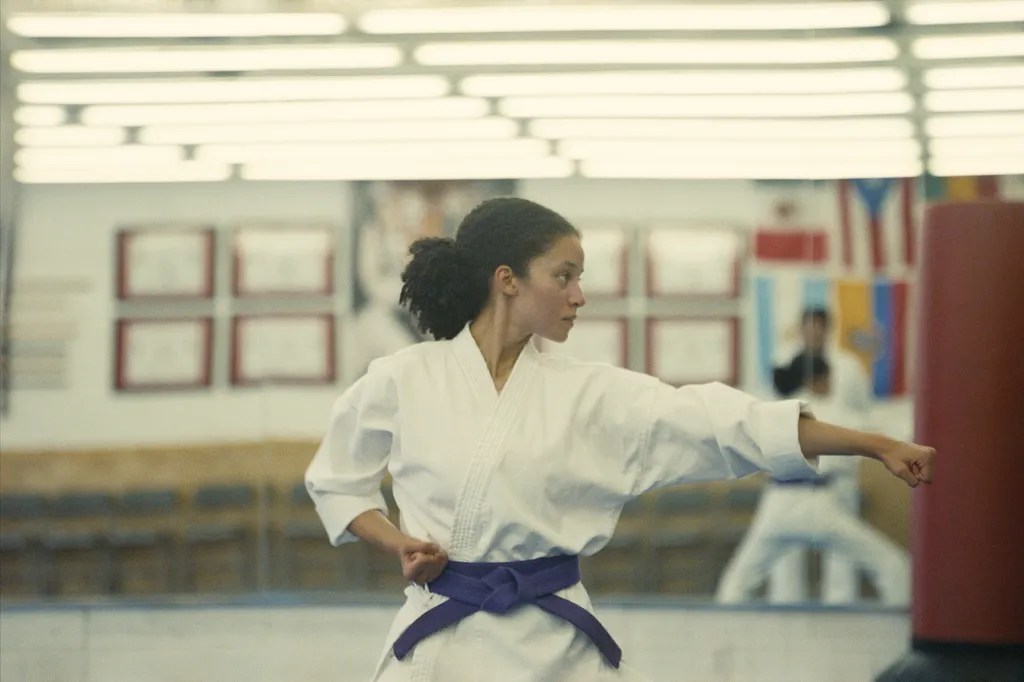
However, he teaches his daughter Willa what she needs to know in case of emergency, and Willa takes karate classes showing how Bob’s approach to the revolution, and to saving the world was instead through raising his daughter and teaching her how to face the world for herself, allowing her to be in control. His actions form the woman she becomes and the actions she takes in the film are never a direct result of Bob, but instead are actions she takes based on what she’s been taught. Bob’s stupidity and incompetency leads him one step behind Willa at all points, but allows him to comfort his daughter and give her love after she’s dealt with the world. Bob exemplifies the passing of the torch between generations in order to give us hope for our future.

And in contrast to Perfidia’s comment on 16 years of no change, Bob discovers a revolution that has a different approach compared to the French ’75. Willa’s karate teacher Sensei Sergio played by Benicio Del Toro offers Bob a helping hand and invites him to his secret “Latino Harriet Tubman situation” in Baktan Cross where a riot is taking place on the streets with the police fighting fire with fire, Sergio’s shop has a community full of people. It’s a safe haven filled with community, love and care and it radiates throughout the scene as you see the respect they all have for each other. Sergio’s approach in comparison to Perfidia displays a palpable difference in allegiance; where the French ’75 was ultimately a narcissistic venture, Sergio’s underground network is selfless and puts those in danger first rather than as an afterthought. As her instructor and mentor, Sensei Sergio’s compassion and morals rub off on Willa too.
Who Are You?
Willa is a culmination of everyone who has influenced her, but is your blood relation enough to define your actions, even if you never knew them?
Lockjaw’s motivation is to take Willa captive, but she doesn’t know why or who he even is. The truth is, Lockjaw is a vile man.. beyond just his actions, Penn nails it with the way he walks and moves his lips makes you feel uncomfortable and you can tell the kind of person he is right away. I mean that name alone cements it, you’re not called Colonel Lockjaw and a good guy at the same time. His actions are a result of an interview he partakes in at the start of the film where he is applying for the Christmas Adventurers’ Club, a white supremacist group that wants to purify America, however to join he can’t have had any relationship with a person of colour, and obviously his relationship with Perfidia was clearly important to him. Worse yet, Perfidia got pregnant not long after their affair, and Lockjaw doesn’t want to take any risks so he makes an excuse to have the military brought down to Baktan Cross after forcing an ex-member to give away the location and names of Bob and Willa.
I have somehow managed to neglect mentioning it so far, but Jonny Greenwood’s score is just phenomenal, although I can’t say that surprised me as he is probably my favourite working composer, but his score for One Battle After Another is special in particular due to the way it can completely dominate a scene and define it. It tells a story of its own. Lockjaw manages to find the hideout and catch Willa, the frame of an empty spacious church hall with Willa one side, and Lockjaw sat on a chair on the other side builds up to the swelling of the score that plays a few times across the film, but the crescendo here specifically is so deeply impactful. It’s so loud, it’s overwhelming and scary and feels like an ultimate confrontation. It turns out to be just that as Lockjaw takes the paternity test, and the results show that Willa is his. This is one of the most powerful scenes of the movie, as Lockjaw tells Willa that being a part of the Christmas Adventurers’ Club is a higher honour than being her father. Radically opposite to Perfidia, and yet both share a higher importance to what they believe is a higher calling compared to their own flesh and blood. Chase Infiniti blows me away in this scene with the devastation she has in her face, but also disbelief and disgust. But she isn’t defined by who her father actually is, she was never defined by who her mother was as both were never there for her. The only person who has always been there for her has always been Bob and always will be Bob. Because of Bob she is able to eventually save herself and handle herself, eventually reuniting with him.
Ultimately, she reads that letter from her mother, one she didn’t know about, and as I said earlier it is so vital to the thesis of the film, and a result of her reading this letter and finally having something real from her mother instead of this fake story of her being a fallen hero, helps Willa really choose what she wants to do, and that’s helping save the world like her mother tried, but failed. However, she isn’t her mother, Willa is her own person defined by those who raised her and not who she’s blood related to, and the ways she can help save the world are through different more effective ways. Of course, Bob is still there supporting her and helping her out but letting her go off on her own and be her own girl instead of sheltering her away out of fear. Anderson instills confidence in younger generations to learn from the mistakes of previous generations. The best way to save the world is to teach future generations the issues and support them so that change can actually happen instead of being caught in a vicious cycle of violence and narcissism.
There is genuinely nothing more vindicating and optimistic than the ending with the “American Girl” needle drop truly instilling confidence and hope in our generation and those who come afterwards.

Ocean Waves
All that messaging and character work is in service of PTA’s first action film, and One Battle is one of the most thrilling films I’ve seen with the expected incredible direction from Anderson. It juggles with a lot of themes, a lot of characters and subplots, and there are certain characters I wish could’ve been utilised more, I think so much of One Battle’s strength is in what it keeps under the surface for those paying attention to understand. The film never says much about Perfidia’s postpartum depression or how she feels about her daughter in reality, but PTA contrasts a scene of Perfidia, Bob and Willa in their bed as repeated twice in two opposite ends of the film, with one showing Bob as the nurturing type where Perfidia is cold, but during the letter from Perfidia, she appears more nurturing. It is what repositioned my thoughts on Perfidia as a person, as which version of this scene was the real one? The truth is it doesn’t matter because even if she didn’t act this way, she clearly had it internalised. She punished herself by choosing to give up motherhood and a family because she felt she didn’t deserve it, and in a way it could be a major reason as to why she threw herself at what was her biggest foe.
The pacing of One Battle is truly insane after watching it twice, it doesn’t ever feel like it’s approaching 3 hours long, and I still can’t understand why. Maybe it’s because it is stacked with things constantly happening and everything feeling necessary with no scenes that drag. It’s truly a perfect edit in my mind, and I really appreciated the usage of fades as a really underrated way to transition a scene and also pair two scenes’ image onto each other to create meaning.
But you can’t talk about One Battle After Another without addressing the iconic road. Anderson’s use of roads, the desert and hills like ocean waves is astounding. Undoubtedly the best car chase I’ve seen in a film by virtue of how genuinely rollercoaster-like it felt. The camera follows the road as if we are actually there, and the cars are just far enough away from each other that each time they approach a hill, their view of what’s behind and in front is compromised and each time you can see properly again it just adds so much to the tension and thrill of the scene. There is a reason the scene has been talked about so much.
There’s honestly a lot more I could talk about but I feel like I talked about everything that could fit into a section instead of being random. It’s just a monumental film and it feels like a true culmination of Paul Thomas Anderson’s previous work while being something completely unlike what’s come before it. As I said earlier, I do believe this is the start of a new era of PTA’s filmography and that’s because PTA is still young in director years, and has so much more left in him that it is nothing but exciting, and to be trusted with an expensive film that could’ve easily not resonated in this climate is a great sign. This is easily my favourite film of the year so far and one of the best films PTA has made, and I don’t say that lightly.
Ultimately, PTA’s earnest optimism but not naivety to the state of the world is exactly what people need, and maybe if we trust future generations and teach them the right way, change can come and there may still be hope. But even in the worst of times, even when the world is a hell-hole, love prevails and family matters, as corny as that sounds. Bob’s love for Willa is unconditional despite blood, and that’s the most beautiful thing.
From here on out, it’s one battle after another.
 Newton's Law
Leave a comment